When delving into the fascinating universe of interior architecture, high-end residential remodeling, and meticulous kitchen design, the passion for oenology ceases to be a casual pastime and becomes a true driving force of contemporary lifestyle and home experience. For true collectors and wine lovers, a modern kitchen must offer infinitely more than conventional pantry storage; it demands advanced refrigeration technical solutions that guarantee the preservation, aging, and optimal tasting of every bottle, controlling with millimeter precision the exact temperature, relative humidity levels, absolute absence of mechanical vibrations, and complete protection against harmful ultraviolet radiation.
However, integrating highly specialized wine refrigeration appliances into a kitchen furniture design that is exquisite, clean, sleek, and minimalist poses a first-rate technical, thermodynamic, and aesthetic challenge. How can we seamlessly merge wine cellars, panel-ready wine coolers, and climate-controlled cabinets into custom woodwork without ever compromising visual aesthetics or ergonomic functionality? We deeply analyze the master keys and key points for integrating wine cellars and cooling units with absolute style, technical rigor, and artisanal mastery.
1. The wine cooler as a sculptural piece: Invisible integration versus scænographic visual prominence
The first major strategic dilemma when planning a cooling cellar within the kitchen is deciding whether the appliance should completely blend into the surrounding cabinetry or, conversely, stand out as a prominent, exhibition-worthy centerpiece.
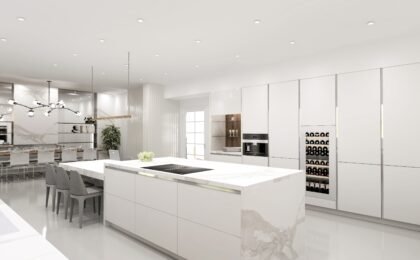
- Panel-ready, fully concealed wine coolers: If we seek a sleek, minimalist aesthetic with continuous lines, the optimal solution is to choose wine cellars specifically designed to be clad with identical door fronts as the rest of the furniture (whether in silky matte lacquer, slatted noble wood, or large porcelain surfaces). When closed, the wine cooler completely disappears from view, maintaining architectural harmony and visual order in the space.
- Glass-fronted with black steel frames and bespoke display: For enthusiasts who wish to showcase their select collection of fine wines as if it were a work of art, cellars with triple-pane glass doors featuring UV solar protection, integrated handles, and ultra-thin metal profiles act like authentic museum display cases, providing unmatched technical sophistication and a focal point of great aesthetic strength.
2. Strategic placement in kitchen design: Ergonomics, thermodynamics, and workflow
The location of a cooling cellar within the kitchen layout never relies on random or purely aesthetic criteria, but rather on rigorous rules of thermodynamic engineering, heat dissipation, and daily operational ergonomics.
- Strict distancing from direct heat sources: It is a non-negotiable technical requirement to avoid placing the wine cooler next to ovens, cooktops, built-in microwaves, dishwashers, or areas of the room directly exposed to intense sunlight. External heat forces the interior compressor to overwork, drastically reducing energy efficiency and severely threatening the thermal stability of the wines.
- Accessibility height and operational comfort: Freestanding or under-counter built-in wine coolers are perfect for quick access in the breakfast bar area or central island. Meanwhile, large-format wine columns integrate masterfully into tall cabinet blocks, positioning the main pull-out shelves at a comfortable ergonomic height for safely handling heavy bottles without forced postures.
3. Vibration control and technical ventilation: The invisible secret of preservation
A high-end wine cellar is not a simple conventional domestic refrigerator; its interior is a delicate and silent ecosystem where acoustic and mechanical insulation is vital for the proper maturation of the liquid.
- High-engineering anti-vibration systems: Professional wine cooler compressors must incorporate floating silentblocks and special rubber shock absorbers to prevent motor micro-vibrations from transmitting to the bottles. Constant movement and continuous vibrations alter the natural sediments of wine and can ruin a reserve vintage irreversibly.
- Hidden perimeter ventilation grilles: For an integrated wine cooler to function optimally over the years, the airflow circuit needs to exhaust accumulated heat from the bottom or rear. Good kitchen design plans for plinths with integrated technical grilles or slotted false ceilings that guarantee a constant airflow without any mechanical elements remaining visible to the user.
4. Removable wood shelving and custom interior design for label protection
The visual, tactile, and functional soul of a cooling cellar lies in its interior design. The trays, supports, and shelves where the bottles rest must combine structural robustness with a refined aesthetic that respects the product.
- Noble wood shelving (untreated oak or beech): Telescopic rails with smooth, progressive extraction and natural wood shelves prevent paper labels from friction scuffs and provide a tactile warmth far superior to traditional chrome wire mesh racks.
- Perimeter LED lighting without residual heat: The arrangement of LED lights in warm tones (around 2700K or 3000K) along the interior frame elegantly highlights the silhouette of the bottles and labels without emitting thermal radiation that alters the interior temperature of the compartment.
5. Dual-temperature or multi-zone configurations for versatile cellars
If the kitchen features a single integrated cellar but simultaneously houses white, sparkling, rosé, and red wines with vastly differing thermal needs, the technical choice should lean toward dual-temperature or multi-zone cellars.
- Compartmental climate independence: These allow the interior of the wine cooler to be fractioned into two or three airtight compartments with independent thermal regulations (for example, between 6°C and 10°C for whites and sparkling wines in the lower zone, and between 16°C and 18°C for aged reds in the upper zone), ensuring each wine is maintained and served at its optimal tasting point.
6. Precise relative humidity control and active air filtration systems
Beyond temperature, the long-term preservation of fine wines depends on invisible environmental factors that must be perfectly automated within the cabinetry and the appliance.
- Maintaining optimal humidity: An atmosphere that is too dry contracts corks, allowing oxygen entry and subsequent premature oxidation of the wine; an overly humid atmosphere encourages mold growth on labels. Professional integrated cellars maintain stable relative humidity ranges between 50% and 80%.
- Active carbon deodorizing filters: The interior air of the wine cooler is constantly renewed through active carbon filters that eliminate suspended particles and bad odors, preventing them from penetrating through the porous cork and altering the organoleptic qualities of the wine.
7. Smart automation, connectivity, and security in the modern kitchen
Domotic technology and smart connectivity have radically transformed how enthusiasts interact with their built-in cooling cellars in high-end furniture.
- Remote monitoring via mobile apps: Smart wine coolers allow users to control and modify temperatures, receive immediate alerts in case of accidental door openings, power outages, or thermal fluctuations directly on their smartphone.
- Soft-close systems and security locks: The incorporation of soft-closing hinges prevents abrupt slamming when closing the cellar doors, while code or key locking systems protect the highest-end and most sentimental bottles from unauthorized access in homes with children.
At Muebles El Valle, we analyze every exclusive kitchen design project by integrating advanced oenological refrigeration solutions. We combine the most demanding technical engineering with impeccable custom woodwork so you can enjoy your favorite fine wines in an environment of maximum security, functionality, and exquisite visual appeal.
0