In the current landscape of interior architecture and high-end residential remodeling, the kitchen has evolved from a mere functional workspace into the true aesthetic and social heart of the home. However, as our homes lean toward clean, minimalist, and completely uncluttered lines, a major logistical challenge arises within any kitchen design project: how to integrate the daily management of household waste and selective recycling without compromising an ounce of visual purity and spatial wellbeing?
Today, environmental sustainability and cutting-edge kitchen design go hand in hand. Efficient waste management is no longer awkwardly hidden under the sink; it demands advanced technical solutions, ergonomic pull-out systems, and custom planning within contemporary kitchen design. We deeply analyze the master keys to integrating hidden recycling zones with absolute style, hygiene, and functionality.
1. The evolution of the traditional bin: Front-pull-out systems and compartmentalized bins
Trash storage has undergone a silent revolution thanks to state-of-the-art hardware engineering. The old independent bins that took up floor space or unattractive tilting doors have become completely obsolete in modern kitchen design.
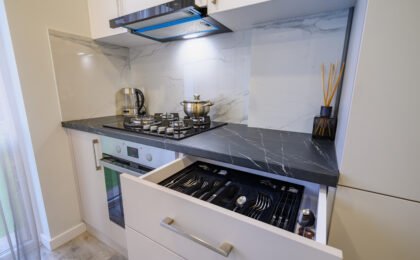
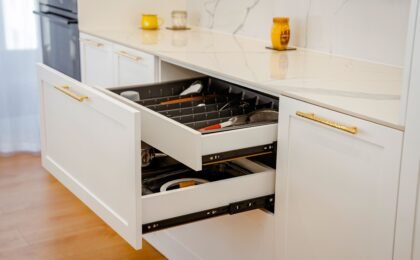
- Full-extension telescopic runners with soft-closing dampeners: Current recycling stations are mounted on high-capacity deep drawer pull-outs equipped with concealed full-extension runners. With a gentle knee touch or via push-open / servo-drive electric systems, the module glides fluidly and silently, allowing users to view and conveniently access all compartments from above.
- Ergonomic multi-section modules: A good kitchen design plans for at least 3 to 4 independent bins of varying capacities to correctly sort packaging, paper, glass, and organic waste, optimizing available space without overcrowding the drawer.
2. Strategic placement in the workflow: Efficiency and ergonomics in the water zone
The golden rule of ergonomics in any kitchen design dictates that the waste management zone must be strategically positioned to minimize unnecessary movement and prevent drips or floor mess during cooking.
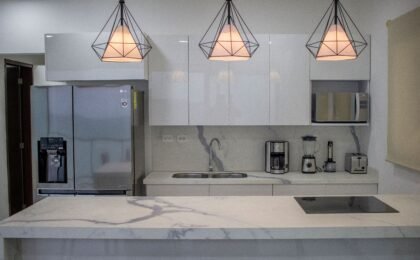
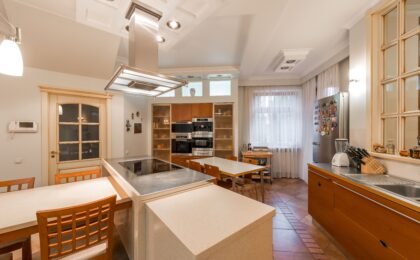
- The axis under the sink and the central island: Traditionally, the bin has been placed beneath the main sink basin. However, in modern kitchens featuring a central island, it is very common to duplicate recycling points or dedicate a specific deep drawer adjacent to the washing and food prep zones.
- Direct access from the work surface: Incorporating a hatch or disposal chute integrated directly into the countertop (whether natural stone, porcelain, or engineered quartz) allows organic or cutting scraps to be swept straight into the lower bin without needing to open drawers while hands are busy or soiled.
3. Odor control and airtight sealing: Technology applied to domestic hygiene
One of the main fears when concealing waste within cabinetry is the accumulation of bad odors and the proliferation of bacteria or moisture, especially with organic waste.
- Airtight lids and active carbon filters: High-end recycling systems feature individual lids sealed with perimeter rubber gaskets that prevent odors from leaking into the cabinet interior. Additionally, many advanced modules include brackets for integrated active carbon filters that neutralize aromas before they escape outward.
- Easy-to-clean antibacterial materials: Bins manufactured from high-quality polymers with silver ion treatments or stainless steel facilitate deep cleaning and prevent residue adhesion and germ formation.
4. Invisible design and aesthetic continuity: Total integration into cabinetry
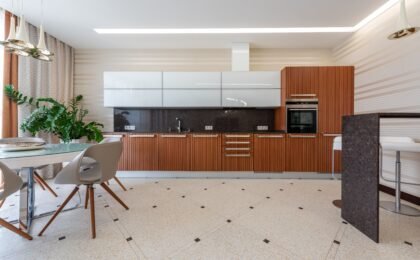
To maintain the streamlined, minimalist aesthetic that characterizes an exclusive kitchen design project, the recycling zone must completely blend into the surrounding millwork.
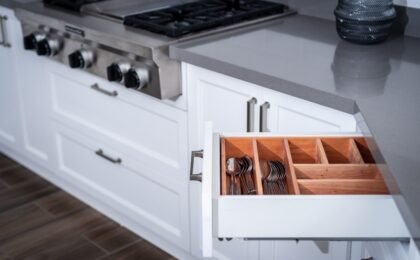
- Continuous fronts without visible handles: Waste containers are hidden behind large deep drawers that exactly mirror the design of the base cabinet fronts or storage columns. When the drawer is closed, the recycling zone completely disappears from view, maintaining a clean, uniform, and sophisticated visual presentation.
- Combination with waste compaction systems: In homes with high volumes of packaging or cardboard, integrating small manual or electrical compactors inside the drawer helps drastically reduce occupied space, spacing out trips to the community dumpster.
5. Integrated domestic composting and organic waste management
Growing ecological awareness has driven the integration of specific solutions for treating organic waste directly within the kitchen design environment.
- Small countertop or drawer composters: Certain high-end kitchens already account for the technical space needed to house accelerated decomposition or odor-controlled devices for organic waste, turning food scraps into dry compost quickly and without olfactory nuisance.
- Clear separation via color coding: To facilitate daily operation for all family members—including the little ones—bin handles and lids often feature standardized color codes or subtle laser-etched signage inside the pull handle, promoting sustainable habits intuitively.
6. Automated interior lighting and complementary accessories
The functionality of a hidden recycling zone is exponentially enhanced when lighting accessibility and interior organization are carefully addressed.
- Perimeter LED strips with opening sensors: Upon pulling out the waste drawer, an integrated LED lighting system turns on automatically, providing clear visibility inside each compartment even in low ambient light or during nighttime hours.
- Extra compartments for bags and cleaning supplies: Utilizing the dead side or rear spaces of the drawer to place custom trash bag dispensers and small eco-friendly cleaning products ensures everything needed for waste management is always at hand and neatly organized.
7. Connectivity and automation in future waste management
Home automation applied to kitchen design has also reached storage and recycling systems, offering an extra layer of technological comfort in daily life.
- Foot-sensor-assisted opening: Motorized opening mechanisms via a subtle touch or proximity sensor located in the furniture plinth allow the trash drawer to be opened with a gentle push of the foot—an extremely hygienic solution when cooking and handling fresh food.
- Smart fill-level indicators: Discreet sensors connected to mobile apps on a smartphone can notify the user when the main compartments are approaching maximum capacity, optimizing household recycling routines.
At Muebles El Valle, we conceive every exclusive kitchen design project by pairing maximum aesthetic demands with smart technical solutions. We optimize every centimeter of your cabinetry so you have a comfortable, hygienic, and fully integrated recycling zone, allowing you to enjoy a sustainable home without sacrificing design or visual comfort.
0