Keeping the kitchen organized is one of the biggest daily challenges, especially when we accumulate food, small appliances, cookware, and cleaning supplies. Having a space dedicated exclusively to storing provisions makes the difference between a chaotic kitchen and a functional, harmonious space.
Integrating a pantry within the cabinetry has become one of the most demanded solutions in modern kitchen design, as it increases storage capacity without sacrificing a clean, uncluttered aesthetic.
Why integrate a pantry into your kitchen design?
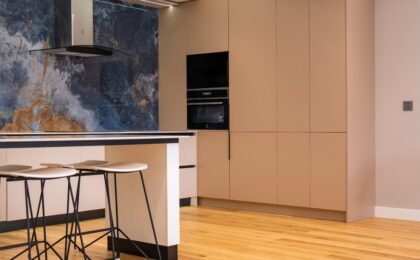
Unlike old standalone pantries, current solutions blend seamlessly with the rest of the furniture through columns and vertical modules that make the most of the room’s height.
A good kitchen design incorporating a pantry cabinet offers great advantages:
- Centralization: All dry foods, preserves, and provisions are grouped in a single, accessible spot.
- Space optimization: It utilizes the depth and height of walls that previously went wastefully unused.
- Flawless aesthetics: When the doors are closed, everything remains hidden behind the furniture fronts, preserving visual minimalism.
Types of pantry cabinets for your kitchen
Depending on the available square meters and your room’s layout, different options adapt to every need:
1. Full-extraction pantries (Pull-out modules)
They are the kings of ergonomics. When opening the cabinet door, a system of metal runners pulls the entire contents outward.
- Main advantage: They let you see everything stored at a single glance, even what is in the very back, preventing forgotten foods from expiring.
2. Cabinets with interior shelves and English drawers
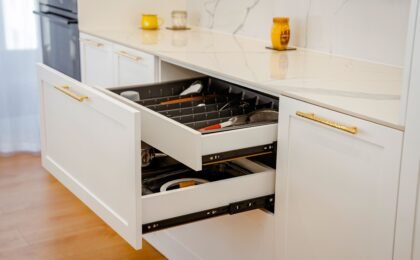
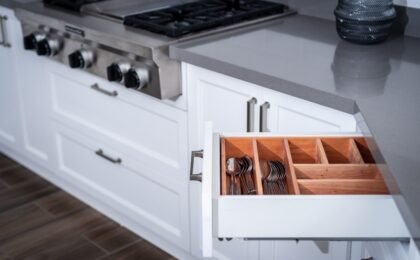
This option combines exterior swing doors with hidden interior drawers (also known as English drawers).
- Main advantage: They offer great loading flexibility. You can pull out only the drawer you need at eye level, making it easy to organize by category (breakfasts, pasta, cans, etc.).
3. Corner pantry cabinets
Making use of corners is usually a challenge in any project. Angled pantry cabinets with rotating systems or kidney-shaped pull-out trays turn dead space into a high-capacity pantry.
4. Column modules with pocket doors
One of the most sophisticated trends in contemporary kitchen design. They allow cabinet doors to retract into the sides when opened, transforming the pantry into a fully accessible mini workstation or breakfast station while cooking, and hiding completely when finished.
Organization keys to maximize interior space
Having a good pantry cabinet is only the first step; organizing it correctly guarantees daily efficiency:
- Zoning by height:
- Middle zone (eye level): Reserve this for daily or frequently used products (coffee, oil, salt, cereals).
- Low zone: Ideal for heavy or bulky items (bottles, milk packs, large pots, or appliances).
- High zone: Use it for occasionally used products or backup provisions.
- Use of transparent jars and containers: Transferring legumes, pasta, and flour into uniform airtight jars not only prevents pantry pest infestations, but also provides a visual aesthetic of absolute order and makes stock control easier.
- Labeling: Identifying jars and baskets helps all family members maintain the organization system over the long term.
Functionality and order tailored to you
A successful kitchen design project must anticipate your storage needs. Investing in a well-planned pantry cabinet simplifies cooking tasks and elevates the comfort of your home.
At Muebles El Valle, we help you design and configure the perfect pantry cabinet for your space. We study every detail of layout and hardware to offer you a kitchen that is as practical on the inside as it is elegant on the outside.
0